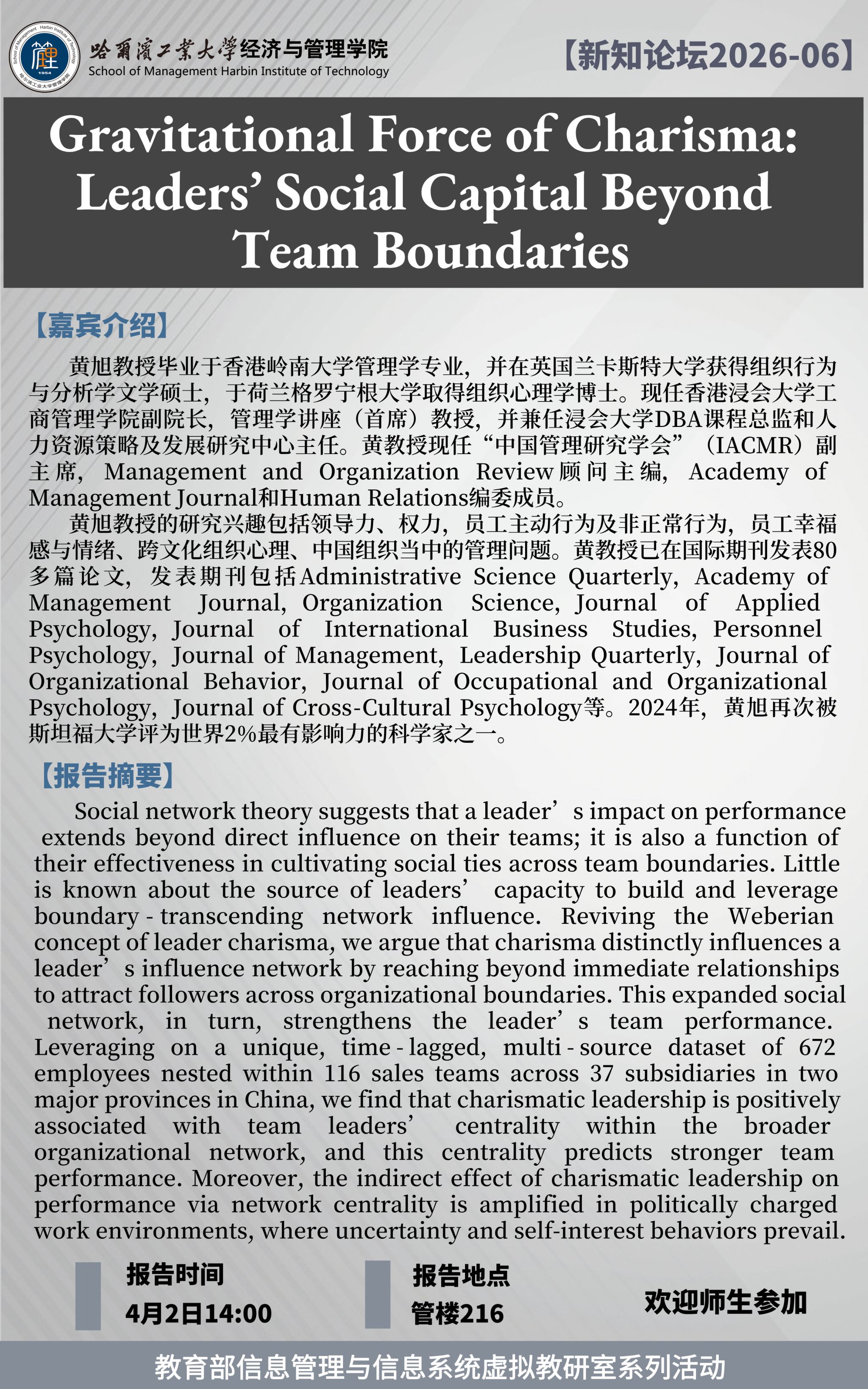
教育部信息管理与信息系统虚拟教研室系列活动
讲座时间:2026年4月2日14:00-16:00
讲座地点:管楼216
讲座主题:Gravitational Force of Charisma: Leaders’ Social Capital Beyond Team Boundaries
讲座嘉宾简介
黄旭教授毕业于香港岭南大学管理学专业,并在英国兰卡斯特大学获得组织行为与分析学文学硕士,于荷兰格罗宁根大学取得组织心理学博士。现任香港浸会大学工商管理学院副院长,管理学讲座(首席)教授,并兼任浸会大学DBA课程总监和人力资源策略及发展研究中心主任。黄教授现任“中国管理研究学会”(IACMR)副主席,Management and Organization Review顾问主编,Academy of Management Journal和Human Relations编委成员。
黄旭教授的研究兴趣包括领导力、权力,员工主动行为及非正常行为,员工幸福感与情绪、跨文化组织心理、中国组织当中的管理问题。黄教授已在国际期刊发表80多篇论文,发表期刊包括Administrative Science Quarterly,Academy of Management Journal,Organization Science,Journal of Applied Psychology,Journal of International Business Studies,Personnel Psychology,Journal of Management,Leadership Quarterly,Journal of Organizational Behavior,Journal of Occupational and Organizational Psychology,Journal of Cross-Cultural Psychology等。2024年,黄旭再次被斯坦福大学评为世界2%最有影响力的科学家之一。
讲座摘要
Social network theory suggests that a leader’s impact on performance extends beyond direct influence on their teams; it is also a function of their effectiveness in cultivating social ties across team boundaries. Little is known about the source of leaders’ capacity to build and leverage boundary-transcending network influence. Reviving the Weberian concept of leader charisma, we argue that charisma distinctly influences a leader’s influence network by reaching beyond immediate relationships to attract followers across organizational boundaries. This expanded social network, in turn, strengthens the leader’s team performance. Leveraging on a unique, time-lagged, multi-source dataset of 672 employees nested within 116 sales teams across 37 subsidiaries in two major provinces in China, we find that charismatic leadership is positively associated with team leaders’ centrality within the broader organizational network, and this centrality predicts stronger team performance. Moreover, the indirect effect of charismatic leadership on performance via network centrality is amplified in politically charged work environments, where uncertainty and self-interest behaviors prevail.