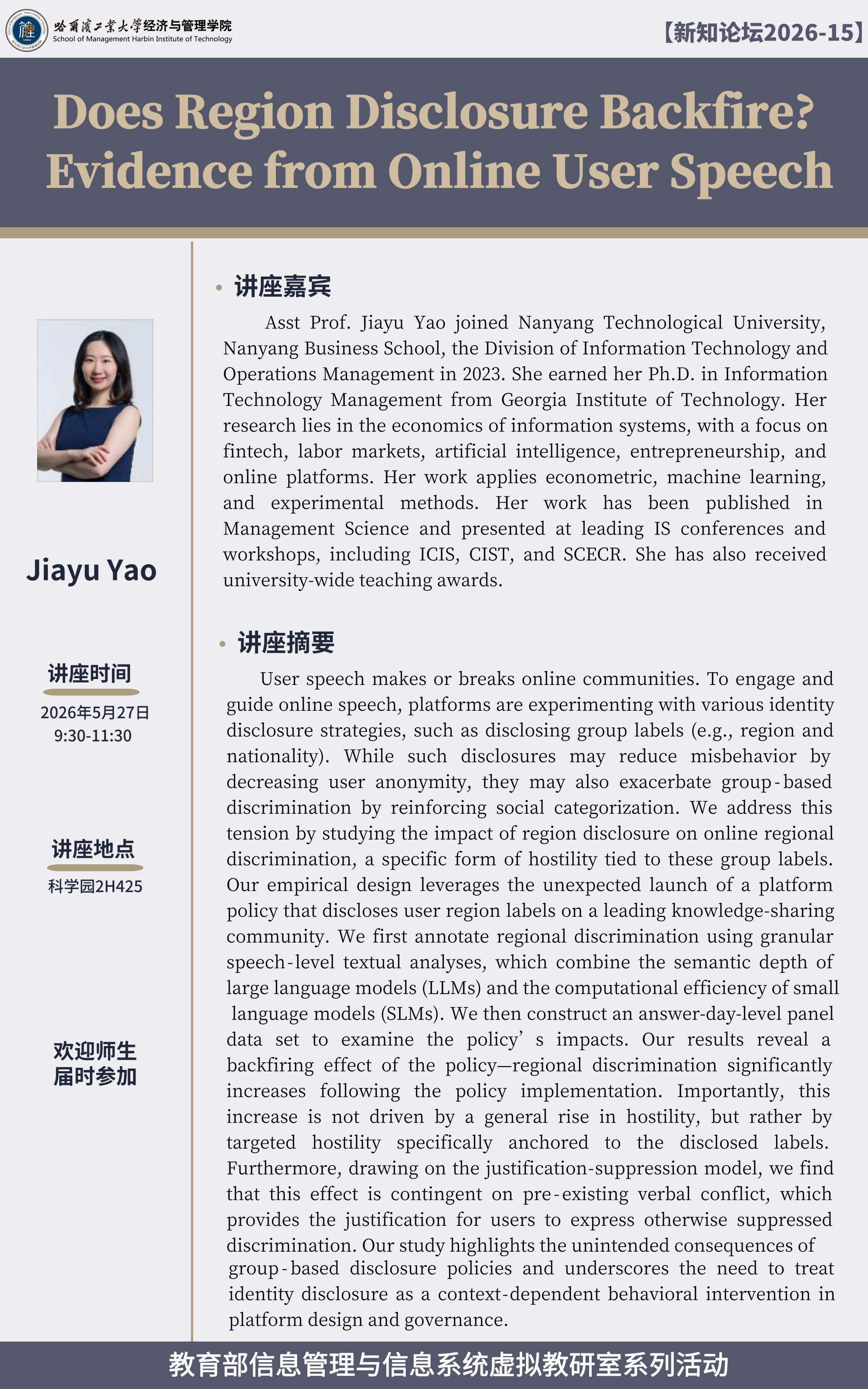
教育部信息管理与信息系统虚拟教研室系列活动
讲座时间:2026年5月27日 9:30--11:30
讲座地点:科学园2H栋425室
讲座主题:Does Region Disclosure Backfire? Evidence from Online User Speech
讲座嘉宾简介
Asst Prof. Jiayu Yao joined Nanyang Technological University, Nanyang Business School, the Division of Information Technology and Operations Management in 2023. She earned her Ph.D. in Information Technology Management from Georgia Institute of Technology. Her research lies in the economics of information systems, with a focus on fintech, labor markets, artificial intelligence, entrepreneurship, and online platforms. Her work applies econometric, machine learning, and experimental methods. Her work has been published in Management Science and presented at leading IS conferences and workshops, including ICIS, CIST, and SCECR. She has also received university-wide teaching awards.
讲座摘要
User speech makes or breaks online communities. To engage and guide online speech, platforms are experimenting with various identity disclosure strategies, such as disclosing group labels (e.g., region and nationality). While such disclosures may reduce misbehavior by decreasing user anonymity, they may also exacerbate group-based discrimination by reinforcing social categorization. We address this tension by studying the impact of region disclosure on online regional discrimination, a specific form of hostility tied to these group labels. Our empirical design leverages the unexpected launch of a platform policy that discloses user region labels on a leading knowledge-sharing community. We first annotate regional discrimination using granular speech-level textual analyses, which combine the semantic depth of large language models (LLMs) and the computational efficiency of small language models (SLMs). We then construct an answer-day-level panel data set to examine the policy’s impacts. Our results reveal a backfiring effect of the policy—regional discrimination significantly increases following the policy implementation. Importantly, this increase is not driven by a general rise in hostility, but rather by targeted hostility specifically anchored to the disclosed labels. Furthermore, drawing on the justification-suppression model, we find that this effect is contingent on pre-existing verbal conflict, which provides the justification for users to express otherwise suppressed discrimination. Our study highlights the unintended consequences of group-based disclosure policies and underscores the need to treat identity disclosure as a context-dependent behavioral intervention in platform design and governance.